


Featured article by Esha Datanwala
 Photo by Carlos Muza on Unsplash
Nowadays, companies and enterprises require more space to store their data, and they can now choose where to store their data based on the size, scope, and cost. Of the many options available for this purpose, two are data warehouses and data marts.
In this article, I will explain the difference between a data warehouse and a data mart and which one is best suited for your company to store data based on your company’s data requirements.
What is a Data Warehouse?
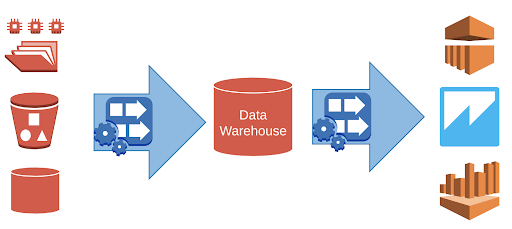
A data warehouse, often known as a single source of truth, is a repository that holds all of an organization’s current and historical data from multiple sources. It’s an important part of a data analytics architecture since it generates a conducive environment for decision support, analytics, BI, and data mining.
You have two options for storing your data in a data warehouse: one is a cloud data warehouse, and the other is a traditional data warehouse. A cloud-based data warehouse architecture fixes the limitations of traditional databases while also being more efficient than traditional data warehouses.
What is a Data Mart?
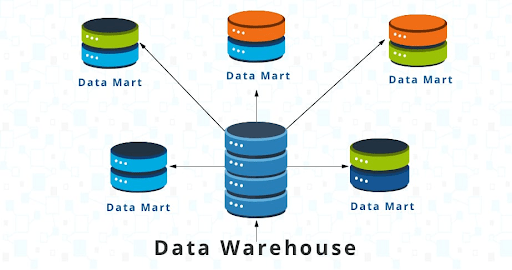
A data mart is similar to a data warehouse, except it exclusively stores data for one department or business line, such as sales, finance, or human resources. A data warehouse can feed information to a data mart, and a data mart may feed information to a data warehouse.
Data warehouses and data marts store structured data and are linked to traditional schemas, which define how records are described and organized. Businesses utilize an ETL tool to extract data from numerous sources and load it into the destination, regardless of the repository they use.
The main difference between a data warehouse and a data mart is that a data warehouse is a data-oriented database. A data mart, on the other hand, is a project-oriented form of a database.
A data warehouse is a centralized relational database designed for analytical rather than transactional operations, capable of analyzing and altering data sets from numerous sources. A data mart, on the other hand, is a decentralized system that often holds warehouse data for a specific purpose, such as meeting the needs of a single line of business or company department.
Comparing Data Marts and Data Warehouses
The primary goal of a data warehouse is to create an integrated environment and a coherent image of the business at a given point in time and consolidate data and become a single source of truth across the business.
A data mart is typically utilized at the department level in a business division. It allows quick access to data for a particular department or line of business.
Data Handling
Data warehousing encompasses a big portion of the organization, which explains why it takes so long to process. On the other hand, data marts can only manage limited amounts of data. They are simple to use, create, and implement. A data mart can keep less than 100 GB of data. However, a data warehouse has a much higher limit.
In a data mart, you can only store summarized data. However, in a data warehouse, you can store several sorts of data, such as raw data, metadata, and summary data. A data mart has a singular emphasis on one line of business, whereas a data warehouse is often enterprise-wide and spans numerous areas. Additionally, a data mart stores data from a few sources, whereas a data warehouse stores data from many sources. Both data warehouses and data marts allow exporting the stored data to external tools for further usage and analysis, e.g., MySQL to Excel or Google Sheets.
Finally, compared to the data stored in data marts, the data kept in a data warehouse is always detailed. Data marts, on the other hand, are designed for specific user groups. As a result, the data is brief and limited.
Scope
Data warehousing has a broader scope and is more useful because it can bring information from any department. A data mart is limited in scope and only contains data from one department of a corporation. There can be separate data marts for sales, finance, marketing, and so on as they have restricted applications.
Subject Area
The primary goal of a data warehouse is to deliver an integrated environment and a consistent image of the business at any given moment in time. On the other hand, data marts often hold only one subject area, such as sales amount. Data warehouses are used for enterprise-wide analysis, whereas data marts are utilized for department-specific analysis.
Focus
Data warehousing is generally targeted across all departments. It may represent the entire company or enterprise-wide library of different data sources. A data mart, on the other hand, is subject-oriented and is employed at the departmental level for a single subject or organizational area.
Time Required
The time it takes to build up the entire process in a data mart is 3-6 months, whereas it takes at least a year in a data warehouse.
Cost
The price of a data warehouse varies but is usually greater than $100,000. With cloud solutions, the cost can be much lower because businesses pay on a per-use basis. On the other hand, data mart prices begin at $10,000.
Conclusion
Well, I hope the abovementioned points have given you clarity regarding where to store your data and which tool is more efficient for you. You can store your data in a data mart if your data is small in size and you do not have much to spend on data storing. On the other hand, you can store your data in a data warehouse if you need more space to store your data and you have enough time and money to spend on data storing.
Click here to view more IT Briefcase content!


